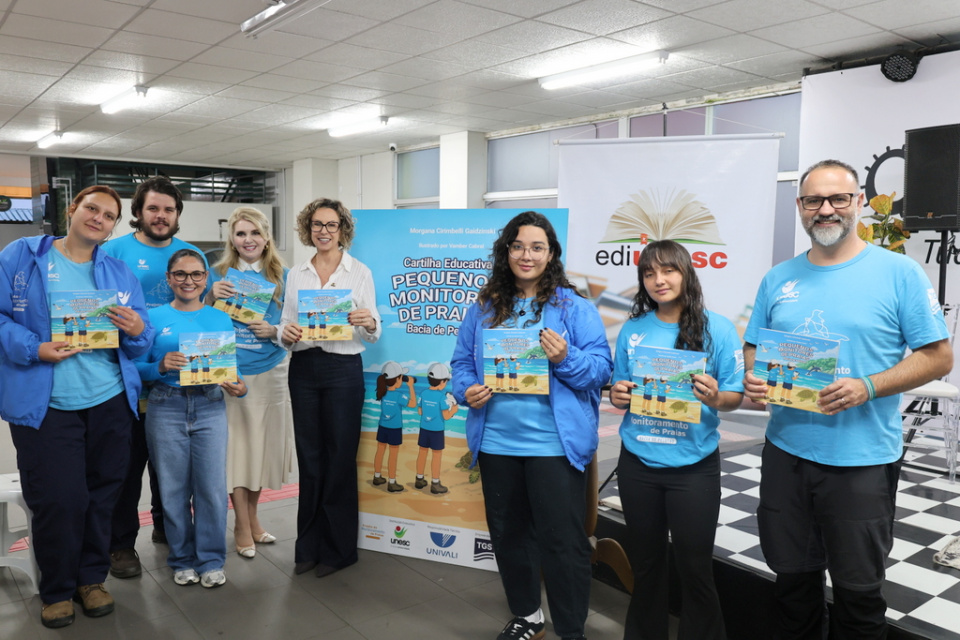
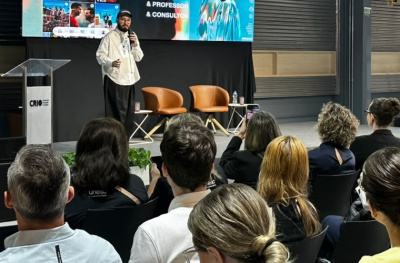
Learn about the animals that inhabit the coastline, understand how beach monitoring works, and discover what to do when encountering a turtle or a seabird on the sand. These are some of the lessons children will find in the publication "Little Beach Monitors of the Pelotas Basin," authored by professor and biologist Morgana Cirimbelli Gaidzinski, with illustrations by Vamber Cabral. The booklet was launched on the evening of Thursday (10/29) at Unesc during the programming of the Science and Technology Week at the University.
With playful language, characters inspired by marine fauna, and illustrations that bring children closer to the world of research, the work presents the biodiversity of the Pelotas Basin, which encompasses the coastline of Rio Grande do Sul and Santa Catarina. The aim is to spark children's curiosity and show that ocean conservation also begins with knowledge and small everyday actions.
For the author, the booklet was born from the desire to share with children a bit of the daily work carried out by professionals involved in beach monitoring. "We are directly involved in this work and know closely the richness of our marine fauna. We want to share a bit of this experience, awakening curiosity in readers and showing that there is a whole research, care, and dedication behind the protection of these animals," explains Morgana.
The Vice-Rector for Research, Graduate Studies, Innovation, and Extension at Unesc, Vanessa Moraes de Andrade, emphasized that the launch of this book highlights the importance of bringing science closer to the community, especially to children, fostering an early interest in knowledge and care for the environment. "Projects like this reflect Unesc's role as a Community University, transforming research into accessible knowledge and contributing to the formation of more conscious citizens regarding the preservation of biodiversity and our coastal environments," she emphasized.
Science that reaches children
Throughout the pages, readers are invited to learn about the importance of oceans, the formation of the Pelotas Basin, the different coastal environments, and the marine seismic research conducted by the company TGS. The publication also explains, in simple terms, what environmental licensing is and how this process establishes measures to assess and prevent possible impacts of activities on the environment.
One of the highlights of the booklet is the presentation of the Beach Monitoring Project of the Pelotas Basin (PMP-BP), developed as a condition of federal environmental licensing, conducted by the Brazilian Institute of Environment and Renewable Natural Resources (Ibama), for TGS's seismic research activities.
The project is funded by the company for its execution and carries out systematic monitoring of the beaches, recording occurrences and attending to marine fauna. The work allows for the gathering of scientific information about birds, turtles, and marine mammals, contributing to understanding the presence of these animals along the coastline, investigating possible causes of mortality, and identifying threats to biodiversity.
At Unesc, responsible for Sector B of the project, which encompasses the stretch between Balneário Rincão and Jaguaruna, monitoring also finds space in environmental education through the Prof. Morgana Cirimbelli Gaidzinski Zoology Museum.
The booklet brings children closer to this reality by showing which animals are monitored, what the researchers' routine is like, which equipment is part of the work, and what precautions should be taken when encountering an animal on the beach.
"Often, when we think of science, we imagine something distant from our reality. But it is present in our daily lives, including at the beaches we visit. Through the booklet, we can show who the professionals involved are, what they do, and why this work is so important for understanding and protecting marine life," says Morgana.
Little monitors, big discoveries
The publication also presents the Educational Program Little Beach Monitors of the Pelotas Basin, developed by the Zoology Museum at Unesc. The initiative expands the experience beyond reading, inviting children to learn about beach monitoring and share what they learn with family, friends, and teachers.
The idea is to ensure that scientific knowledge transcends the pages of the booklet and reaches homes, schools, and communities, fostering a more attentive perspective towards marine life and the preservation of coastal environments.
"We want to train little monitors, children who observe nature more closely, recognize animals, and know how to act when they encounter one on the beach. They can also share this information with their parents, friends, and teachers. This way, knowledge circulates and reaches more and more people," emphasizes the professor.
For Morgana, bringing childhood closer to environmental issues is a way to build a relationship of respect with nature from an early age. "When a child learns to look at the sea, at the animals, and at everything that exists in this environment with curiosity and respect, they begin to understand that they also have a responsibility in this care. That is what we wish for with this material: that each child feels part of this story," she concludes.