Course Overview
The undergraduate program in Economics focuses on providing students with strong skills in understanding and solving issues. The goal is to train ethical entrepreneurs committed to development. Graduates of the program are well-prepared to analyze transformations, make decisions, and solve problems that affect society.
Differentials
- The Economics program at Unesc offers unique courses such as Capital Markets, Corporate Finance, and Econometrics;
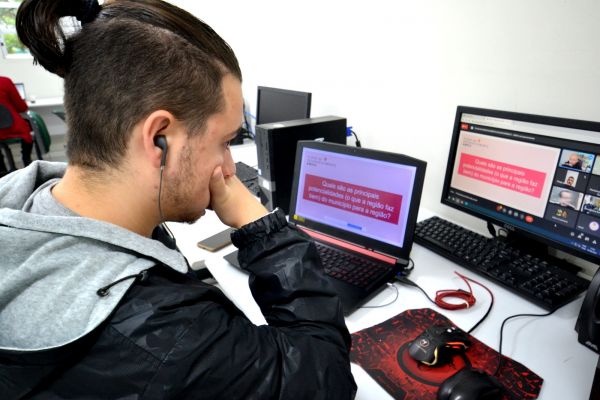
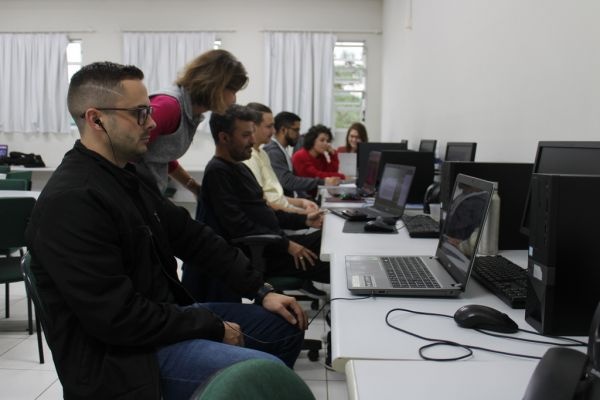
- Center for Practice in Economics: A specialized laboratory for the program equipped with software for statistical projections and economic scenario analysis;
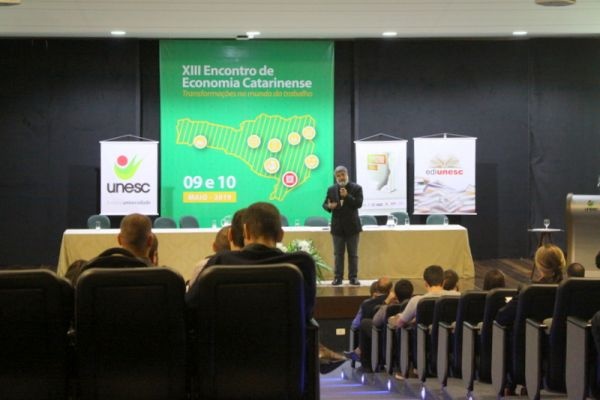
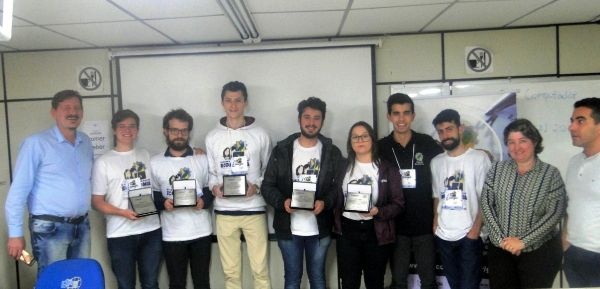
- Participation in state and national events, visits to the Stock Exchange and large companies, and lectures with renowned national and international economists.
What will you learn?
The Bachelor’s degree in Economics prepares you for work in the capital markets, engaging in stock trading on the Stock Exchange. In the program, you will also learn to interpret the impacts of macroeconomic policies on the local environment, assisting in strategic decision-making for businesses and the public sector.
Additionally, you will gain technical tools to develop macro-regional projects in the socio-economic-environmental area aimed at the common good. You will develop knowledge to identify vulnerable points in a company, presenting possible alternative solutions. This practice also takes into account ethics and social responsibility.
Job Market
The Bachelor’s degree in Economics allows you to work in various areas of the market. The focus is on the financial market, economic consulting, market studies, and economic feasibility of ventures.
You can enter fields such as companies of all sizes (micro, small, medium, and large), securities brokerage (stock market), auditing and consulting, regulatory agencies and state institutions, economic expertise, judicial arbitration, mergers and acquisitions, project development, environment, and infrastructure.
Subjects
| (NCI)-FORMATIVE LAB I: OUR PLACE AND THE FUTURE |
| (NCA)-QUANTITATIVE METHODS |
| INTRODUCTION TO MACROECONOMICS |
| ECONOMIC DATABASES |
| HISTORY OF ECONOMIC THOUGHT |
| (NCA)-STATISTICS |
| (NCI)-FORMATIVE LAB II |
| MACROECONOMICS I |
| QUANTITATIVE METHODS APPLIED TO ECONOMICS |
| POLITICAL ECONOMY |
| (NCA)-GENERAL INTRODUCTION TO LAW |
| (NCC)-FINANCIAL MATHEMATICS |
| ECONOMIC STATISTICS |
| DEVELOPMENT AND SUSTAINABILITY |
| MACROECONOMICS II |
| GENERAL ECONOMIC HISTORY |
| (NCC)-FINANCIAL AND INVESTMENT ANALYSIS |
| MACROECONOMICS III |
| MICROECONOMICS I |
| SOLIDARY ECONOMY AND COOPERATIVISM |
| ECONOMIC FORMATION OF BRAZIL |
| ECONOMETRICS I |
| (NCC)-BUSINESS ACCOUNTING |
| CONTEMPORARY BRAZILIAN ECONOMY I |
| MICROECONOMICS II |
| RURAL ECONOMICS |
| PUBLIC SECTOR ECONOMICS |
| ECONOMETRICS II |
| (NCI)-FORMATIVE LAB III |
| CORPORATE FINANCE |
| INDUSTRIAL ECONOMICS |
| MONETARY AND FINANCIAL ECONOMICS |
| CONTEMPORARY BRAZILIAN ECONOMY II |
| CAPITAL MARKETS |
| MARKET ANALYSIS AND INTELLIGENCE |
| FINAL COURSE PROJECT I |
| INTERNATIONAL ECONOMICS |
| ECONOMY OF SANTA CATARINA |
| ORGANIZATIONAL MANAGEMENT |
| CORPORATE FINANCE AND DERIVATIVES |
| (NCC) - PROJECT DEVELOPMENT AND ANALYSIS |
| ECONOMICS OF TECHNOLOGY AND LABOR |
| ELECTIVE |
| FINAL COURSE WORK II |
Academic Exclusive
Complementary Activities
Complementary Activities, or AC, are mandatory teaching, research, and extension actions, with a defined workload in your course's curriculum, to be developed by you, student, throughout your educational journey, realized through academic, scientific, cultural, sports, artistic, and technological innovation activities.
The purpose of Complementary Activities is to provide flexibility in the course curriculum and to offer you, the student, the opportunity for thematic and interdisciplinary deepening beyond the subjects, programs, and projects that make up the pedagogical project of the course, adding value to your academic training.
The purpose of Complementary Activities is to provide flexibility in the course curriculum and to offer you, the student, the opportunity for thematic and interdisciplinary deepening beyond the subjects, programs, and projects that make up the pedagogical project of the course, adding value to your academic training.
Regulation of complementary activities
Awaiting publication
Final Paper
...
Library
The Central Library Prof. Eurico Back – UNESC, has the mission to “Promote quality information retrieval, focusing on the development of teaching, research, and extension activities, combining technology and humanized service.”
With free access to the shelves, the Library is located in an area of 2,688.50 m². The service hours are from Monday to Friday, from 7:30 AM to 10:00 PM, and on Saturdays from 8:00 AM to 1:00 PM.
The collection of books, periodicals, and multimedia, as well as the services of technical processing, local database consultation, periodical registration, loan, renewal, return, and reservation are fully computerized by the PERGAMUM Program, which was developed by the Data Processing Center of PUC/Paraná - PUCPR. The location of the works is organized by author, title, subject, or keyword.
The Collection Development Policy of the Central Library aims to define and implement criteria for the development of collections and the updating of the collection.
The Library's collection consists of 82,668 titles and 167,836 volumes of books, has 63 subscriptions to periodicals, and provides access to over 100 databases through the CAPES Periodicals Portal and other publicly accessible databases. It has a subscription to Minha Biblioteca, a database with over 11,000 e-books, in addition to the UpToDate and RT-Online databases.
Periodicals and Databases
-
...
-
...
-
...
Internship
Access here the Internship website
Coordination
Meet the course coordinators:-
Igor Martello OlssonCoordinator
-
Thiago Rocha FábrisDeputy Coordinator
Ratings Ranking

3
grade
CPC
4
grade
CC
WHAT IS IT LIKE TO STUDY HERE?
Step into the world of the course
Press play on the video

.jpg)