Course Overview
The Mathematics undergraduate program at Unesc is one of the oldest courses at the institution, ensuring a solid theoretical and practical foundation, including knowledge of numerous relationships within mathematical disciplines. This education fosters an understanding of the historical process of knowledge construction in the field, allowing students to perceive the teaching practice of Mathematics as a dynamic process, filled with uncertainties and conflicts, a space for creation and reflection, where new knowledge is continuously generated and modified.
Differentials
- It has an excellent evaluation by MEC, Enade, and the Student Guide;
- Being a face-to-face program, it has a differentiated structure, with laboratories and a faculty mostly composed of Masters and Doctors;
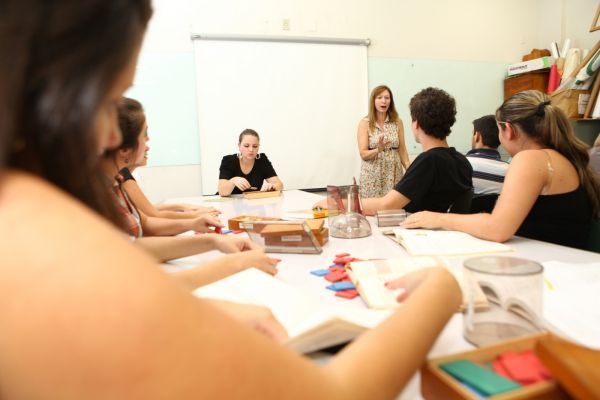
- Infrastructure with computer labs, a Mathematics lab, classrooms equipped with data projectors and digital whiteboards;
- Computer labs equipped with software applied to Mathematics, such as Maple, Cabri, Graph, and Geogebra;
- Opportunity to participate in research and extension projects, as well as in the institutional teaching initiation scholarship program (PIBID);
- Opportunity to participate in teaching projects through Promat Junior Company of the Mathematics course;
- Possibility to participate in the Free University program of the Government of the State of Santa Catarina;
- The Licentiate courses at UNESC feature integrated and innovative curricular matrices;
- Scholarships of up to 100%.
What will you learn?
The Mathematics-Licentiate course prepares you to perform the role of a teacher in Basic Education. For this, you will learn to organize the teaching of mathematical concepts based on pedagogical conceptions and the documents that govern Education at the federal, state, and municipal levels. Additionally, it allows for the analysis, selection, and production of teaching materials that assist in the learning process of students.
It enables the creation of teaching strategies that promote creativity, autonomy, and flexibility in students' mathematical thinking, focusing more on concepts than on techniques, formulas, and algorithms. It will contribute to the realization of collective projects within basic education.
Job Market
The Licentiate in Mathematics trains teachers qualified to work in Elementary and High School, with a solid mathematical and didactic-pedagogical background to operate in all education networks.
Subjects
[dropdown-title]Matrix 6[/dropdown-title]
[dropdown-content]
| (NCI)-FORMATIVE LAB I: OUR PLACE AND THE FUTURE |
| (NCA)-PRACTICE AS A CURRICULAR COMPONENT - PCC I |
| (NCC)-HISTORY OF EDUCATION |
| GEOMETRIC DRAWING |
| GEOMETRY I |
| ELEMENTARY MATHEMATICS I |
| (NCA)-PRACTICE AS A CURRICULAR COMPONENT - PCC II |
| (NCA)-PHILOSOPHY |
| (NCA)-TEXT PRODUCTION AND INTERPRETATION |
| GEOMETRY II |
| ELEMENTARY MATHEMATICS II |
| DIFFERENTIAL AND INTEGRAL CALCULUS I |
| (NCA)-PRACTICE AS A CURRICULAR COMPONENT III |
| (NCC)-LEARNING THEORIES |
| (NCC)-SOCIOLOGY OF EDUCATION |
| EXPERIMENTAL LAB I |
| DIFFERENTIAL AND INTEGRAL CALCULUS II |
| STATISTICS |
| ANALYTIC GEOMETRY |
| (NCA)-PRACTICE AS A CURRICULAR COMPONENT - PCC IV |
| (NCA)-PEDAGOGICAL PROCESSES OF INCLUSIVE EDUCATION |
| (NCC)-DIDACTICS |
| COMMERCIAL AND FINANCIAL MATHEMATICS |
| DIFFERENTIAL AND INTEGRAL CALCULUS III |
| EXPERIMENTAL LAB II |
| (NCA)-PRACTICE AS A CURRICULAR COMPONENT - PCC V |
| (NCA)-MANAGEMENT OF EDUCATIONAL PROCESSES |
| (NCA)-PEDAGOGICAL PROCESSES OF DIGITAL CULTURE |
| INTERNSHIP I: ELEMENTARY EDUCATION I |
| LINEAR ALGEBRA I |
| DIFFERENTIAL AND INTEGRAL CALCULUS IV |
| (NCI)-FORMATIVE LAB II |
| (NCA)-PRACTICE AS A CURRICULAR COMPONENT - PCC VI |
| (NCA)-POLICIES AND STANDARDS OF BASIC EDUCATION |
| INTERNSHIP: ELEMENTARY EDUCATION II |
| PROBABILITY |
| LINEAR ALGEBRA II |
| ALGEBRA I |
| (NCA)-PRACTICE AS A CURRICULAR COMPONENT - PCC VII |
| (NCA)-LIBRAS |
| (NCA)-EDUCATION AND HUMAN RIGHTS |
| PHYSICS I |
| INTERNSHIP: HIGH SCHOOL I |
| MATHEMATICAL ANALYSIS I |
| ALGEBRA II |
| (NCA)-PRACTICE AS A CURRICULAR COMPONENT - PCC VIII |
| APPLIED MATHEMATICS |
| PHYSICS II |
| INTERNSHIP: HIGH SCHOOL II |
| MATHEMATICAL ANALYSIS II |
| NUMERICAL CALCULUS |
Matrix 5
HISTORY OF EDUCATION
SOCIOLOGY OF EDUCATION
PRACTICE AS A CURRICULAR COMPONENT I
GEOMETRIC DRAWING
GEOMETRY I
ELEMENTARY MATHEMATICS I
SCIENTIFIC METHODOLOGY AND RESEARCH
PHILOSOPHY
PRACTICE AS A CURRICULAR COMPONENT II
GEOMETRY II
DIFFERENTIAL AND INTEGRAL CALCULUS I
ELEMENTARY MATHEMATICS II
LEARNING THEORIES
TEXT PRODUCTION AND INTERPRETATION
PRACTICE AS A CURRICULAR COMPONENT III
ANALYTIC GEOMETRY
STATISTICS
DIFFERENTIAL AND INTEGRAL CALCULUS II
DIDACTICS
PEDAGOGICAL PROCESSES OF INCLUSIVE EDUCATION
LIBRAS
PRACTICE AS A CURRICULAR COMPONENT IV
DIFFERENTIAL AND INTEGRAL CALCULUS III
EXPERIMENTAL LABORATORY
COMMERCIAL AND FINANCIAL MATHEMATICS
PEDAGOGICAL PROCESSES IN DIGITAL CULTURE
MANAGEMENT OF EDUCATIONAL PROCESSES
PRACTICE AS A CURRICULAR COMPONENT V
DIFFERENTIAL AND INTEGRAL CALCULUS IV
SUPERVISED INTERNSHIP IN ELEMENTARY EDUCATION I
ALGEBRA
POLICIES AND STANDARDS OF BASIC EDUCATION (PNOEB)
PRACTICE AS A CURRICULAR COMPONENT VI
LINEAR ALGEBRA I
SUPERVISED INTERNSHIP IN ELEMENTARY EDUCATION II
ELECTIVE I
PRACTICE AS A CURRICULAR COMPONENT VII
LINEAR ALGEBRA II
MATHEMATICAL ANALYSIS I
SUPERVISED INTERNSHIP IN HIGH SCHOOL I
ELECTIVE II
PRACTICE AS A CURRICULAR COMPONENT VIII
PROBABILITY
MATHEMATICAL ANALYSIS II
SUPERVISED INTERNSHIP IN HIGH SCHOOL II
ELECTIVE III
Academic Exclusive
[title-dropdown]Thesis[/title-dropdown]
[content-dropdown]...
[/content-dropdown]
[title-dropdown]Library[/title-dropdown]
[content-dropdown]
The Central Library Prof. Eurico Back – UNESC, has the mission to "Promote quality information retrieval, focusing on the development of teaching, research, and extension activities, combining technology and humanized service."
With open access to the shelves, the Library is located in an area of 2,688.50 m². The service hours are from Monday to Friday, from 7:30 AM to 10:00 PM, and on Saturdays from 8:00 AM to 1:00 PM.
The collection of books, periodicals, and multimedia, as well as the services of technical processing, local database consultation, periodical registration, loan, renewal, return, and reservation are fully computerized by the PERGAMUM Program, which was developed by the Data Processing Center of PUC/Paraná - PUCPR. The location of the works is organized by author, title, subject, or keyword.
The Collection Development Policy of the Central Library aims to define and implement criteria for the development of collections and the updating of the collection.
The Library's collection consists of 82,668 titles and 167,836 volumes of books, has 63 subscriptions to periodicals, and provides access to over 100 databases through the CAPES Periodicals Portal and other publicly accessible databases. It has a subscription to Minha Biblioteca, a database with over 11,000 e-books, in addition to the UpToDate and RT-Online databases.
[/content-dropdown]
[title-dropdown]Periodicals and Databases[/title-dropdown]
[content-dropdown]
-
...
-
...
-
...
[/content-dropdown]
[title-dropdown]Internship[/title-dropdown]
[content-dropdown]
Access here the Internship website
[/content-dropdown]
Coordination
Meet the course coordinators:-
Lucas Sid Moneretto Búrigo.Coordinator
-
Eloir Fátima Mondardo CardosoDeputy Coordinator
Ratings Ranking

3
grade
CPC
4
grade
CC
WHAT IS IT LIKE TO STUDY HERE?
Step into the world of the course
Press play on the video