From the dream of the community, Unesc is born
Discover the rich journey and history of contribution to our region
The history of Unesc dates back to the mid-1960s, when Southern Santa Catarina was experiencing economic growth. In Capivari de Baixo, the region welcomed the Capivari Thermoelectric Society (Solteca), which controlled the Jorge Lacerda Thermoelectric Plant, while the State of Santa Catarina was implementing a goals plan aimed at developing the financial, transportation, energy, and telecommunications sectors.
These goals were outlined during the administration of Irineu Bornhausen (1951-1955), continued under Jorge Lacerda and Heriberto Hülse (1956-60), and more effectively with the Plameg - Government Goals Plan, during the administration of Celso Ramos (1961-65).
“Against the backdrop of recession, at the end of a period of centralized planning before the military coup of 1964, the Government of Santa Catarina developed its goals plan, which focused on building basic social capital by investing in energy, transportation, and education. Planning, as a political will to change infrastructure, effectively began in 1961 with Plameg (Government Goals Plan) during Celso Ramos's administration (1961-65). Documentarily, Plameg was the result of the Socioeconomic Seminar promoted by the Federation of Industries of the State of Santa Catarina (FIESC) in collaboration with the National Confederation of Industry (CNI) and the Economic Commission for Latin America and the Caribbean (ECLAC) in 1959 and 1960, coordinated by Celso Ramos, then President of FIESC. For the preparation of the Seminar, a series of working meetings were held in 16 cities in Santa Catarina, attended by over 2,000 people. Subsequently, seven regional meetings were held, resulting in 18 sectoral documents that pointed out the structural deficiencies of the Santa Catarina economy. Finally, the Socioeconomic Seminar took place in Florianópolis, where the Final Document was prepared, constituting one of the best diagnoses of the Santa Catarina economy made up to that point (Schmitz, 1985). The Document highlighted deficiencies in infrastructure and made proposals to address them, as well as critiquing the “particularistic view of industrial problems” (Federation of Industries of the State of Santa Catarina, 1960, p. 1). It is important to note that Plameg was not merely the result of this seminar or the personal efforts of Governor Celso Ramos. It was the product of a new growth pattern that had been developing in previous years, which was on the verge of breaking apart, meaning that the capitalist accumulation movement orchestrated institutional changes to unleash productive forces.”
Source: Alcides Goulart Filho, State Planning in Santa Catarina from 1955 to 2002.
In this context, the then-mayoral candidate Ruy Hülse brought to his electoral campaign the commitment to establish a higher education institution in Criciúma.
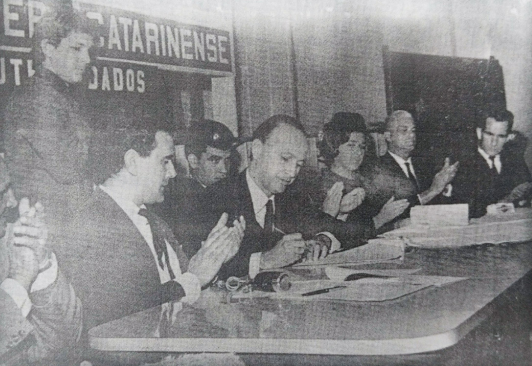
Elected in 1965, Hülse governed Criciúma from 1966 to 1970 and fulfilled his promise during this period. A mayor known for many projects, he was also responsible for the construction of the old city hall of Criciúma, located at the corner of Anita Garibaldi and São José Streets, and paved Nereu Ramos Square, among other infrastructural works for the city. Ruy Hülse was born in Criciúma on February 7, 1926, exactly in the year the Municipality was established.
Hülse graduated in Civil Engineering from the Federal University of Rio Grande do Sul (UFRGS), but it was in politics, following in the footsteps of his father Heriberto Hülse, that he built a solid career, serving as a state deputy for three terms from 1955 to 67. He presided over the Assembly in 1957. His last term as a deputy was interrupted when he took over as Mayor of Criciúma. After this period, he returned to institutional work as president of the Union of Coal Extraction Industry of the State of Santa Catarina (Siecesc).
As a way to consolidate this social appeal for the establishment of higher education in the region, a large community movement was organized. This moment led to the Socioeconomic Studies Seminar for the Implementation of University Education in Southern Santa Catarina, held on June 22 and 23, 1968, which included the participation of educators, intellectuals, politicians, magistrates, community leaders from organized civil society, and the press. As a result of this entire process, Mayor Ruy Hülse enacted Law No. 697 on June 22, 1968, which created Fucri - University Foundation of Criciúma, with courses focused on teacher training.
“Thus, the creation of Fucri marks the founding milestone of Higher Education in the extreme south of Santa Catarina and was undoubtedly a significant event for both the municipality of Criciúma and the region it serves as a hub.”
Source: Professor João Batista Bittencourt, in the book Unesc – The Journey of a Community University.
The institutional structure was organized into a Curatorial Council, a Technical-Pedagogical Council, and an Executive Board.
Fucri is the maintainer of the first higher education institution established in Southern Santa Catarina. The entity emerged from a regional community movement that culminated in a seminar on the implementation of higher education in Southern Santa Catarina. The event included the participation of educators, intellectuals, politicians, magistrates, community leaders from organized civil society, and the press.
Fucri was established by Law No. 697, on June 22, 1968, with courses focused on Teacher Education, and as the South of the State grew, additional programs were created to meet business demands. Fucri underwent statutory changes in 1973 and 1988, being recognized as a public utility by Federal Decree No. 72454/73, State Decree No. 4336/69, and Municipal Decree No. 723/69. Fucri began its activities at the Madre Tereza Michel School, offering a pre-university course. In 1971, it started operating at the General Oswaldo Pinto da Veiga Technical School - SATC - and in June 1974, it moved to the current University Campus, located in the University Neighborhood in Criciúma.
Until September 1991, Fucri maintained four Teaching Units: Faciecri, Esede, Estec, and Escca. With the initiation of the University Process, several actions were taken, including the unification of regulations and the creation of Unifacri (Union of Colleges of Criciúma), resulting from the integration of the four schools.
On September 24, 1991, the State Council of Education, through Opinion 256/91, approved the unified regulations of Unifacri. The process of transforming Unifacri into Unesc was submitted to the Federal Council of Education in 1991 and approved in August 1992, by Opinion 435/92 from CFE. In 1993, due to the transfer of the authority to create universities to the State Council of Education, the Unesc project was submitted to the CEE, which, in February 1993, established the Monitoring Commission, tasked with overseeing the transformation process of Unifacri into Unesc.
On June 3, 1997, the State Council of Education unanimously approved the report of the Reporting Counselor, and in a plenary session on June 17, 1997, also unanimously approved the transformation into the University of Southern Santa Catarina (Unesc), which defined its mission as "promoting regional development to improve the quality of life," with Fucri as its maintainer.
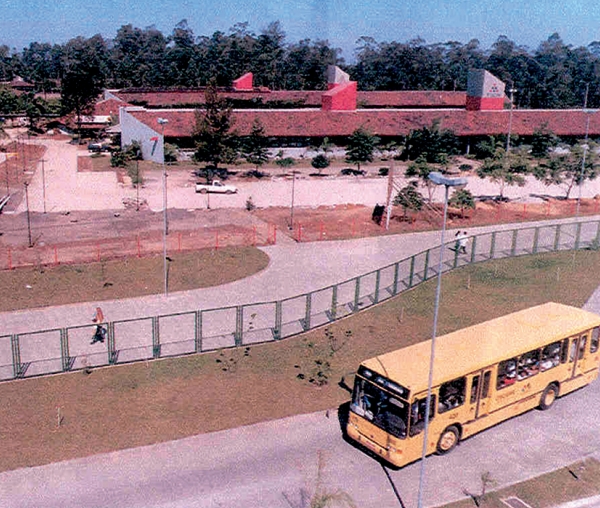
On August 11 of that year, the University received its homologation, equivalent to a 'birth certificate,' signed by the Secretary of Education, João Mattos, in the presence of the Vice-Governor José Augusto Hülse.
On November 18, the official installation of Unesc took place at the Elias Angeloni Theater, with the participation of authorities, business leaders, professors, students, and staff of the Institution.


